Caramelized Onion Sourdough Bread With Gouda – Crave The Good

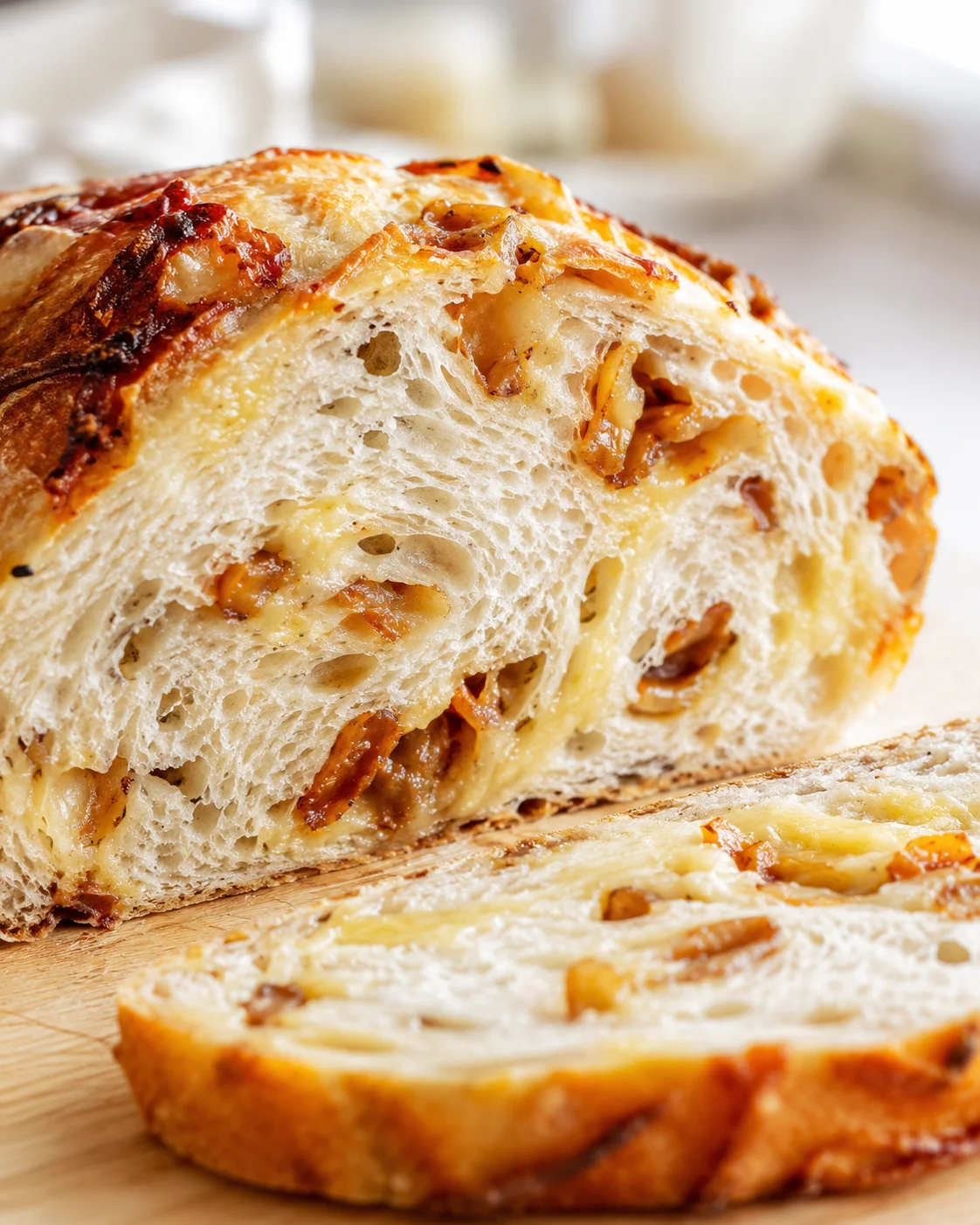
This loaf is one that friends and family keep asking me to bake again. It’s packed with deeply caramelized onions, nutty aged Gouda, and tangy sourdough—this Caramelized Onion And Gouda Sourdough Bread is truly worth every minute you spend making it.
What it is: A savory sourdough loaf bursting with sweet caramelized onions and rich, melted Gouda cheese, baked to perfection with a chewy crumb and a crisp, golden crust.
Why you’ll love it: The mix of sweetly caramelized onions with nutty Gouda cheese makes every slice a bold, comforting bite.
How to make it: Combine active sourdough starter with water and flour, mix the dough, then fold in cooled caramelized onions and shredded cheese during the stretch and fold steps. After bulk fermentation, shaping, proofing (cold retard optional but recommended), bake at 450°F until beautifully golden and crisp.
While sweet sourdough breads are a blast to bake, the ones that really steal the show are savory. This Caramelized Onion Gouda Sourdough Bread delivers mouthwatering flavor that might just have you baking loaf after loaf!
This bake is perfect if you’ve done sourdough before and want to take your loaf to the next level. Just follow along carefully—it’s absolutely worth the effort.
Never caramelized onions before? No worries—I’ll guide you through each step. The toughest part is just waiting for those onions to slowly turn golden and sweet.
This caramelized onion Gouda sourdough is all about big, satisfying flavor.
Expert Tips
- I chose to caramelize the onions fresh for this recipe, but caramelized onion jam is a fantastic shortcut if you’re short on time!
- I do my bulk fermentation and proofing around 70°F. If you’re in a warmer climate, keep an eye on your dough since warmer temps speed up rising.
Expect rich, savory flavor with every bite. This Caramelized Onion and Gouda Sourdough has a chewy, open crumb and a crisp, golden crust. It’s the kind of bread everyone will want you to bake again and again. Lucky for you, I’ve got the full recipe and steps right here.
This is an intermediate sourdough that rewards patience. You’re looking at roughly 19 hours from start to finish when you include the cold retard in the fridge (see the recipe card for prep and cook times). You’ll need a fed, active sourdough starter and some simple tools—a Dutch oven or cloche for baking, plus a banneton for proofing. But if you’ve made sourdough before, the process is pretty straightforward.
Step by step, I’ll walk you through making caramelized onions just right, when to fold in your delicious inclusions, the stretch-and-fold method, and how to prove and cold retard so you get maximum flavor.
- What you’ll learn: how to caramelize onions slowly and correctly, when and how to add the onions and cheese, the rhythm of laminating and stretch-and-fold techniques, and tips for proofing and cold-retarding for the best results.
- What to expect: hearty, savory slices—about 10 per loaf—that are fantastic for grilled cheese, tasty sandwiches, or simply toasted with a pat of butter.
Why the Flavors Sing
Caramelizing the onions brings out incredible depth through the Maillard reaction. Slowly cooking onions over medium-low heat breaks down their sugars, creating those rich, brown flavor compounds that give the same wonderful depth as your sourdough crust’s color and crunch. This process creates a sweet and nutty complexity that pairs beautifully with aged Gouda’s flavor.
Aged Gouda’s low moisture is a game-changer for your crumb. Unlike younger cheeses, aged Gouda has shed much of its water content during aging, so it melts slowly and evenly. You’ll notice a similar gentle melt and savory richness with aged Gruyere in Creamy Mushroom Gruyere Pasta, which helps illustrate why low-moisture cheeses behave so well in bakes.
Cold proofing hits two important notes. The long, cool retard slows fermentation, letting organic acids develop which give sourdough its complex flavor—much like the bright tang celebrated in Tangy Dill Pickle Sourdough Bread. It also firms the dough so it holds its shape better during scoring and bakes with a better oven spring.
Ingredients You’ll Need
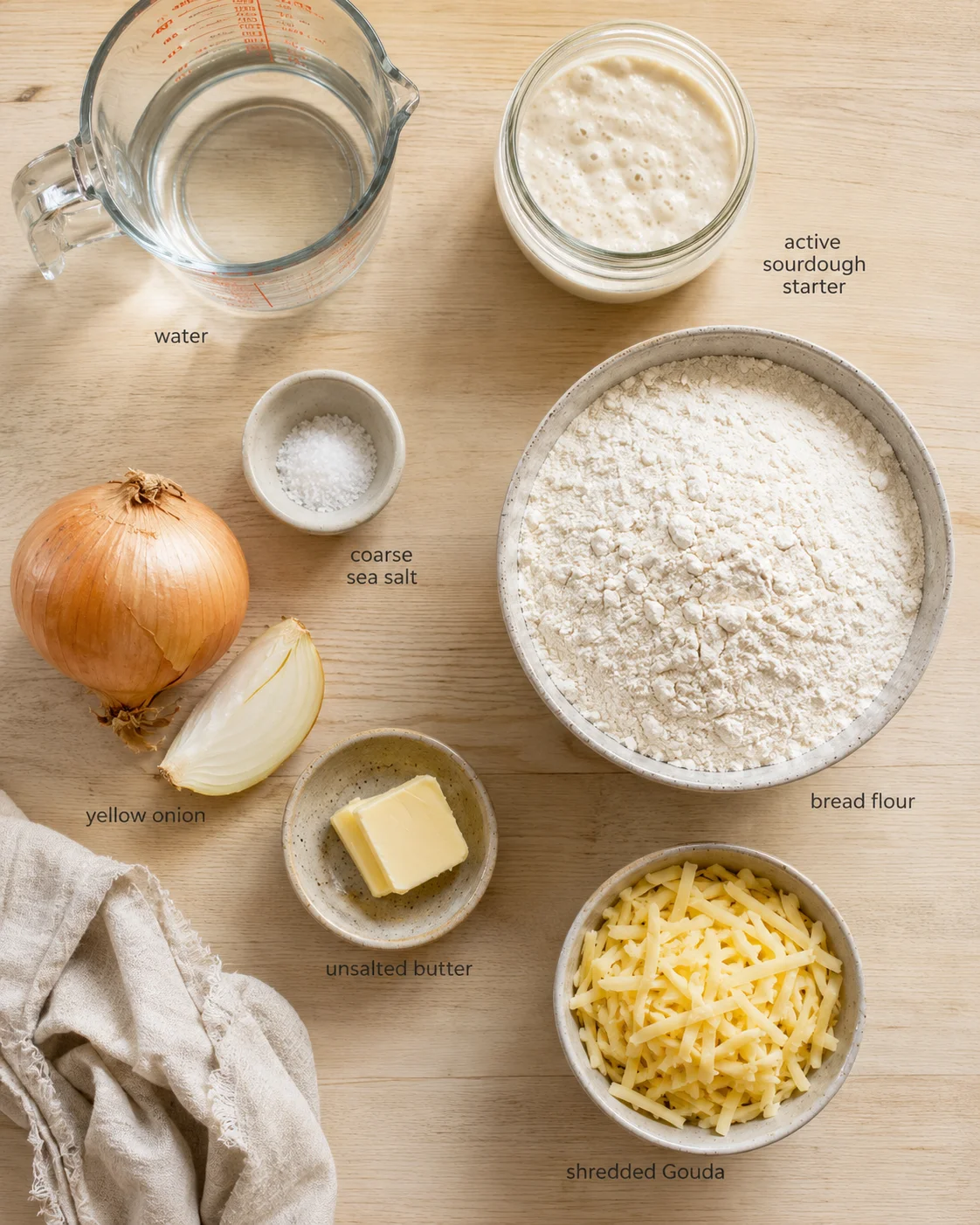
- 350 g water, room temperature
- 100 g sourdough starter, active
- 500 g bread flour
- 12 g sea salt, coarse
- 1 yellow onion, medium-large
- 2 tablespoons butter, unsalted
- 80 g Gouda, shredded
Step-by-Step Method
- Pour 350g room-temperature water into a large bowl and whisk in 100g active sourdough starter until mostly combined and smooth.
- Pour 500g bread flour over the starter mixture and sprinkle 12g coarse sea salt on top.
- Mix with a Danish dough whisk, spatula, or spoon until a shaggy dough forms, then knead briefly by hand to incorporate any dry flour.
- Cover the bowl and let the dough rest 60 minutes.
- With damp hands stretch a flap of dough and fold it over, rotate the bowl 90° and repeat three more times for one set; cover and rest 60 minutes.
- Repeat the stretch-and-fold set once more and let the dough rest another 60 minutes.
- Thinly slice one medium-large yellow onion and add it to a heavy skillet with 2 tablespoons unsalted butter.
- Cook the onions over medium-low heat, stirring frequently, until they are deeply browned and caramelized.
-
Transfer the caramelized onions to a container and chill in the fridge until ready to use.
- Lightly dust the work surface with flour and turn the dough out; gently press and stretch it into a large rectangle, resting a few minutes if it resists or tears.
- Spread about half (≈120g) of the chilled caramelized onions over the top two-thirds of the dough and sprinkle half the shredded Gouda over the onions.
- Fold the bottom third of the dough up, then spread half of the remaining onions and cheese onto that folded section.
- Fold in the bottom right corner by about one-third of the dough’s width, then repeat on the left side and press to seal.
- Spread the remaining onions and Gouda over the top of the dough and fold it down to form a neat package.
- Use a bench scraper to lift the dough and place it into a clean, large bowl; cover and bulk ferment for 2 hours.
- Turn the dough out onto a lightly floured surface and gently press it into a rectangle.
- Fold the bottom third up like a letter, fold the right third across, then the left third; roll from the folded bottom into a log and cover to rest 30 minutes.
- Uncover, flip the dough, bring the ends toward the center and press to seal; rotate 90° and pinch to form a batard, pressing seams firmly.
- Dust the shaped dough with rice flour and place it seam-side up into a banneton.
- Proof the dough in the banneton 2–3 hours at room temperature, then optionally cover and refrigerate to cold retard for up to 3 days.
- Place a Dutch oven or cloche in the oven and preheat to 450°F.
- Invert the banneton onto parchment paper and transfer the loaf onto the parchment.
- Score the surface with a lame, sharp knife, or razor blade to control expansion.
- Using the parchment as a sling, place the loaf into the preheated Dutch oven, cover, and bake at 450°F for 30 minutes; uncover and bake another 10–15 minutes until deep golden and the loaf sounds hollow when tapped (internal temp 205–210°F).
- Remove the bread from the Dutch oven and transfer to a wire cooling rack; cool completely for at least 2 hours before slicing.
Tips for Best Results
- I always caramelize fresh onions for the best flavor, but if you need a time-saver, caramelized onion jam works wonderfully in this recipe!
- My dough likes 70°F for bulk fermentation and proofing. If your kitchen is warmer, watch your dough closely—it will rise faster.
Honestly, this bread is amazing just sliced plain. We devoured a few loaves during recipe testing that way! But if you want to jazz it up, try these ideas:
- The ultimate grilled cheese—melty and packed with flavor (or go for a Swiss mushroom melt).
- Homemade croutons for a smoky French onion soup.
- Simple toasted slice with butter, because sometimes simple wins.
- Sandwiches loaded with smoky pulled pork and this flavorful bread, plus a side of Southern coleslaw with vinegar dressing.
My caramelized onion sourdough bread didn’t turn out right—what now?
Let’s diagnose some common mistakes that come up during the process and impact your loaf:
Undercaramelized onions: If your onions are lightly browned or soft after 15 minutes, they’re not caramelized. Proper slow cooking is key for real onion flavor.
Adding warm onions: Always cool onions fully before folding in or you risk disrupting fermentation from warmed dough areas.
Over-proofing: Sugars from onions feed yeast extra, so your dough may rise faster than usual. Look for a domed surface and slight jiggle rather than relying strictly on timing.
Slicing too early: Due to cheese moisture, this bread needs a full 2-hour cool before slicing to avoid gummy texture.
How should I store caramelized onion and Gouda sourdough bread?
Keep your loaf fresh by following these tips:
For up to 12 hours, store cut side down on a cutting board to keep crust crunchy. Usually, we eat it fast enough it doesn’t get too crusty! After that, transfer to a bread bag or loosely wrap in a kitchen towel for best freshness over 2–3 days.
You can also freeze it. Cool loaf completely, wrap tightly in plastic, slide into a bread or freezer bag, and freeze for 1-2 months. To use, thaw at room temp for 1–2 hours before slicing.
Can I use smoked Gouda instead of aged Gouda?
Yes, smoked Gouda is a fantastic swap. It adds just a hint of smokiness that pairs really well with sweet caramelized onions. It melts and behaves similarly to aged Gouda. Just avoid very young or soft versions to keep dough manageable.
What’s the hydration on this caramelized onion sourdough?
This dough is 70% hydration before adding onions and cheese (350g water to 500g flour). The caramelized onions contribute some extra moisture, making the effective hydration slightly higher. That’s why chilling onions and using bread flour (for strong gluten) help keep things balanced and sturdy.
Mix-Ins and Substitutions
- No cheese: Skip the Gouda and boost caramelized onions to 150g. You’ll still get a delicious loaf.
- Smoked Gouda: Swap in smoked Gouda in the same amount and method for a subtle smoky twist.
- Caramelized onion jam shortcut: Use 80–100g of good-quality store-bought onion jam if you want to skip caramelizing. Just reduce the dough water by about 10–15g to avoid excess moisture.
- Whole wheat: Replace up to 100g of bread flour with whole wheat flour for a nuttier flavor and a slightly denser crumb.
Storing and Keeping Fresh
Make sure your loaf cools fully—at least 2 hours—before storing. Slicing warm bread results in a gummy texture, so patience is key.
- Short-term (room temperature): For the first 12 hours, keep your cut side down on a board to protect the crust. After that, move it to a bread bag or loosely wrap it in a paper or kitchen towel. The loaf stays best for about 2 to 3 days, but note the cheese and onions can speed up staling compared to plain sourdough.
- Refrigeration: Avoid fridge storage. It actually makes bread go stale faster and dries out the crumb.
- Freezing (best for longer storage): Once fully cooled, wrap your loaf tightly in plastic wrap and pop it in a sealed freezer bag. It freezes well for 1–2 months. For convenience, slice first and freeze slices separated by parchment paper.
Thawing & reheating:
- If freezing whole, unwrap and let it thaw at room temp for 1–2 hours before slicing. To refresh, heat the whole loaf in a 350°F oven for 10–15 minutes. For frozen loaves, heat wrapped in foil at 350°F for 20–30 minutes, then unwrap and finish uncovered for 5–10 minutes to crisp.
- For slices, toast or warm in the oven (350°F for 5–8 minutes) for crispness. Avoid microwaving slices, which can make the crumb gummy.
Make-ahead notes:
- This recipe allows up to 3 days of cold retard at the proof stage to develop super deep flavor and bake when you’re ready.
- Caramelized onions and shredded Gouda can both be prepared in advance and stored in the fridge for quicker assembly on bake day.
Common Questions Answered
Q: How do I know when my onions are properly caramelized?
A: Properly caramelized onions will be deeply browned, sweet, and jammy, not just soft. If they’re done in 15 minutes, they’re likely only softened, not caramelized. Cook them low and slow, stirring often, until they reach a rich golden-brown color.
Q: Can I leave out the Gouda or use a different cheese?
A: Absolutely. No cheese? Just increase caramelized onions to about 150g. Smoked Gouda is a great substitute—same amount and method. Avoid very young or high-moisture cheeses that could slick your dough and cause problems.
Q: My dough feels wetter after adding the onions and cheese—what should I do?
A: Make sure your caramelized onions are fully cooled before folding them in since warm inclusions add moisture and heat. Also, using bread flour helps keep dough structure strong. If the dough feels slack while shaping, give it a short rest to relax and firm back up. The cold retard also tightens the dough before baking.
Q: How do I know when my loaf is ready to bake?
A: Look for a domed, bubbly top after bulk fermentation and a light jiggle in the banneton during proof. Once baked, an internal temperature of 205–210°F means it’s done.
Q: Is cold retard necessary?
A: It’s not mandatory—you can bake right after the final proof if you want. But cold retard improves flavor complexity and strengthens dough for better shape and oven spring.
Q: Can I use store-bought caramelized onion jam instead of making my own?
A: Yes! Use about 80–100g of a good-quality caramelized onion jam. Just reduce your dough water by around 10–15g to balance extra moisture from the jam.
Q: What condition should my sourdough starter be in before starting?
A: Use an active, recently fed starter that has doubled in volume. This recipe calls for 100g of starter.
Q: How should I store and reheat the baked loaf?
A: Let the bread cool completely (minimum 2 hours). Keep it cut side down on a board for 12 hours, then cover loosely in a bag or towel. For freezing, wrap tightly and freeze for 1–2 months. To refresh, heat whole at 350°F for 10–15 mins, or frozen wrapped loaf for 20–30 mins plus 5–10 mins uncovered for crust. Toast slices instead of microwaving to avoid gummy crumb.
Q: My crumb was gummy—what likely went wrong?
A: Common reasons include slicing too soon (don’t cut until fully cool), underbaking (bread should hit 205–210°F inside), or adding warm onions that disrupt fermentation. Follow the cooling and inclusion cooling tips above for the best results.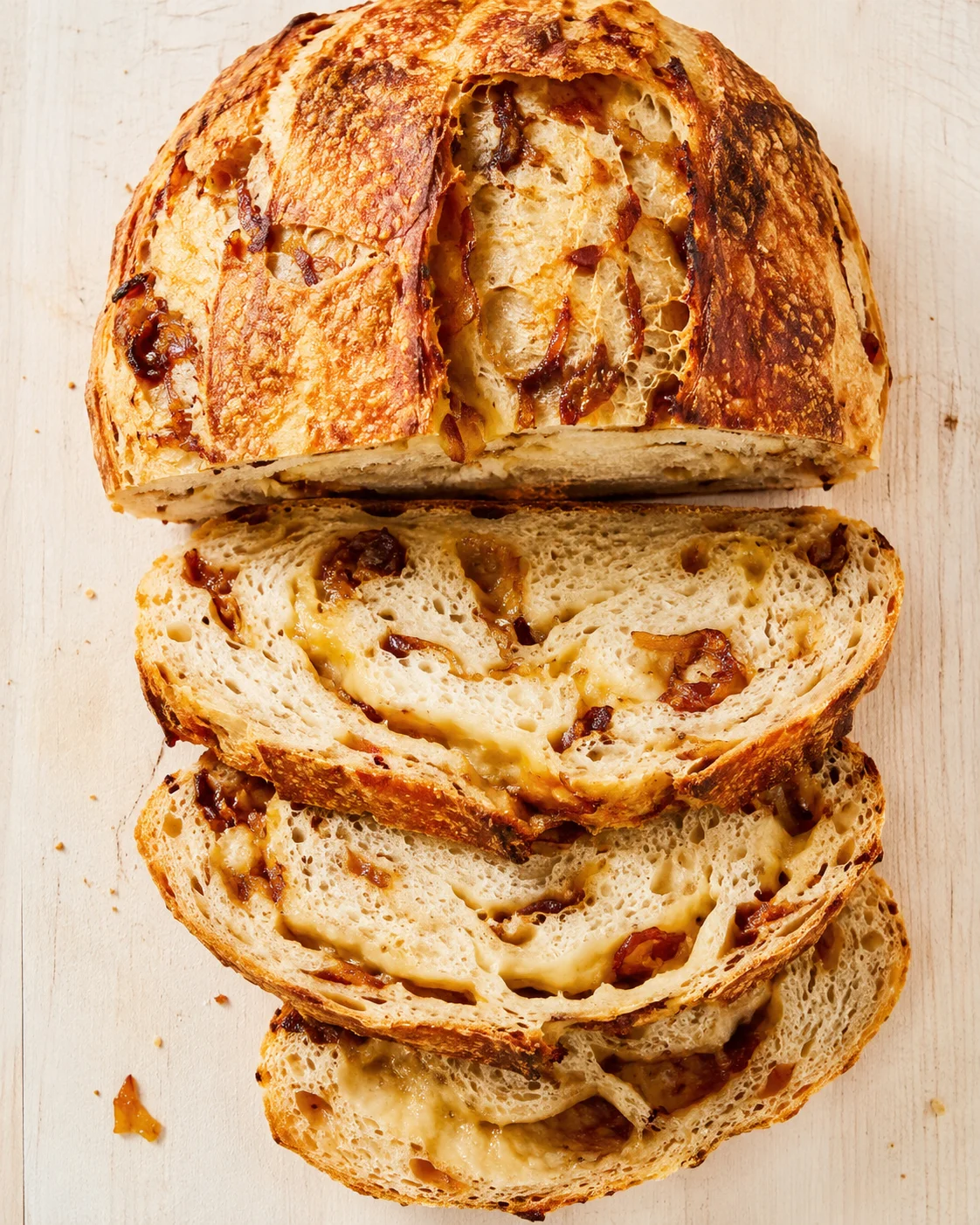
A savory sourdough loaf packed with deeply caramelized onions and nutty aged Gouda cheese, featuring a chewy crumb and crisp golden crust.
- Total Time: 19 hours
- Yield: 10 slices 1x
Ingredients
- 350 g water, room temperature
- 100 g sourdough starter, active
- 500 g bread flour
- 12 g coarse sea salt
- 1 medium-large yellow onion
- 2 tablespoons unsalted butter
- 80 g Gouda, shredded
Instructions
- Pour 350g room-temperature water into a large bowl and whisk in 100g active sourdough starter until mostly combined and smooth.
- Pour 500g bread flour over the starter mixture and sprinkle 12g coarse sea salt on top.
- Mix using a Danish dough whisk, spatula, or spoon until a shaggy dough forms, then knead briefly by hand to incorporate any dry flour.
- Cover the bowl and let the dough rest for 60 minutes.
- With damp hands, stretch a flap of dough and fold it over itself; rotate the bowl 90 degrees and repeat three more times for one full set; cover and rest for 60 minutes.
- Repeat the stretch-and-fold set once more and let the dough rest an additional 60 minutes.
- Thinly slice one medium-large yellow onion and add it to a heavy skillet with 2 tablespoons unsalted butter.
- Cook onions over medium-low heat, stirring frequently, until deeply browned and caramelized.
- Transfer caramelized onions to a container and chill in the fridge until ready to use.
- Lightly dust a work surface with flour and turn the dough out; gently press and stretch it into a large rectangle, resting a few minutes if it resists or tears.
- Spread about half (≈120g) of chilled caramelized onions over the top two-thirds of the dough; sprinkle half of the shredded Gouda over the onions.
- Fold the bottom third of the dough up, then spread half of the remaining onions and cheese onto that folded section.
- Fold in the bottom right corner about one-third width of the dough, then repeat on the left side; press to seal.
- Spread remaining onions and Gouda over remaining dough and fold down to form a neat package.
- Use a bench scraper to lift dough into a clean large bowl; cover and bulk ferment for 2 hours.
- Turn dough onto a lightly floured surface and gently press into a rectangle.
- Fold the bottom third up like a letter, then fold right third across and left third; roll from folded bottom into a log; cover and rest 30 minutes.
- Uncover, flip dough, bring ends toward the center and press to seal; rotate 90 degrees and pinch to form a batard shape, pressing seams firmly.
- Dust shaped dough with rice flour and place seam-side up into a banneton basket.
- Proof dough in banneton for 2–3 hours in a warm spot, then optionally cover and refrigerate to cold retard for up to 3 days.
- Preheat oven to 450°F with Dutch oven or cloche inside.
- Invert banneton onto parchment paper and transfer loaf onto it.
- Score surface with a lame, sharp knife, or razor blade to control expansion.
- Using parchment as a sling, place loaf into preheated Dutch oven; cover and bake at 450°F for 30 minutes, uncover and bake an additional 10–15 minutes until deep golden and hollow sounding when tapped; internal temperature should reach 205–210°F.
- Remove bread from Dutch oven and transfer to wire cooling rack; cool completely at least 2 hours before slicing.
Notes
Caramelized onion jam can substitute fresh caramelized onions as a time-saver; reduce dough water by 10–15g if using jam to account for extra moisture., Cold retardation is optional but recommended to develop flavor and improve dough handling and oven spring., Use bread flour for stronger gluten to balance moisture from onions and cheese., If warm onions are added, they may disrupt fermentation; cool onions fully before folding in., Smoked Gouda can be used as a substitute for aged Gouda for a subtle smoky flavor., Avoid very young or high-moisture cheeses to prevent soggy dough or bursting crust., For best results, proof dough at around 70°F; warmer temperatures speed up fermentation and require closer monitoring., Do not slice bread before fully cooled to prevent gummy crumb texture., Storage tips: keep cut side down for first 12 hours, loosely wrapped thereafter for 2–3 days; freeze fully cooled loaf wrapped tightly for 1–2 months; reheat to refresh crust.
- Prep Time: 1 hour 20 minutes
- Cook Time: 45 minutes
- Category: Sourdough
- Cuisine: American
Nutrition
- Serving Size: 1 slice
- Calories: 243 kcal
- Fat: 5 g
- Carbohydrates: 39 g
- Protein: 8 g